20/10/2026 00:14
Khmer Demo, English Listing? YouTube Translated Titles for Cambodian Luggage Shops
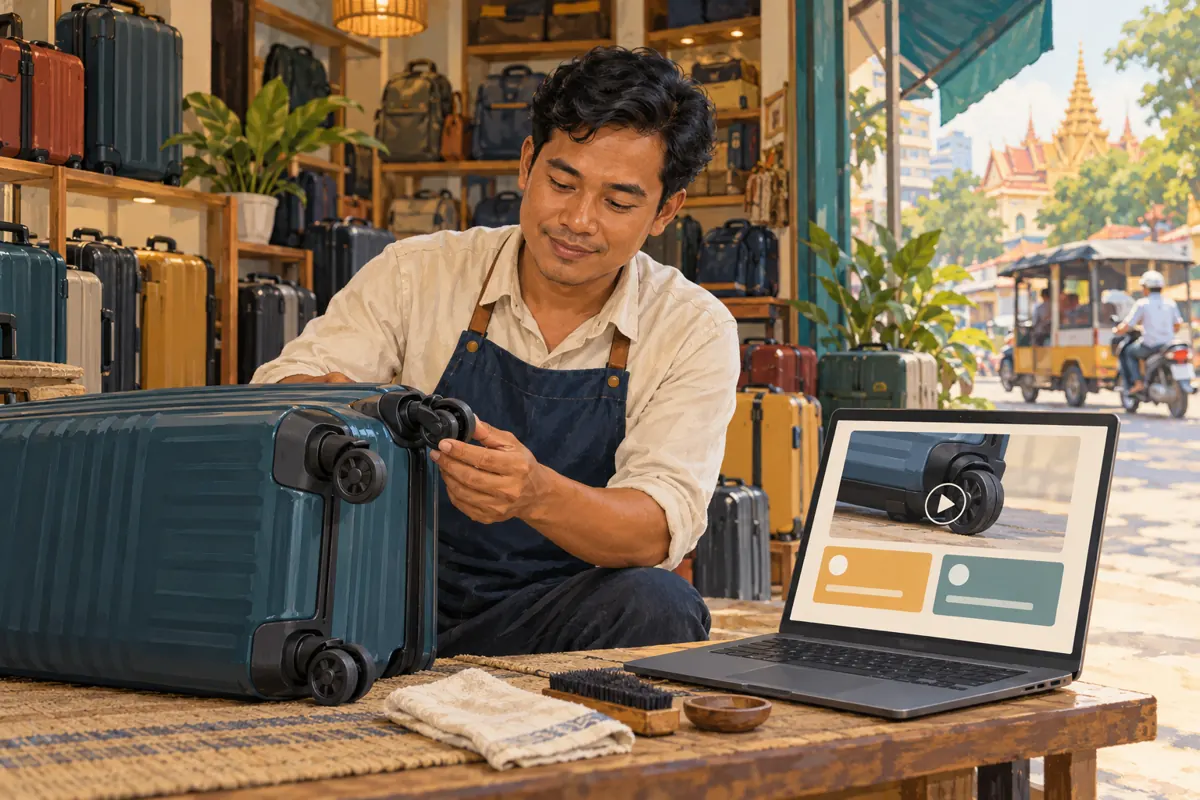
A useful suitcase repair demonstration can still leave a potential customer unsure what they are watching. A Cambodian shop might explain a damaged wheel clearly in Khmer, while an English-reading viewer cannot identify the subject from the listing. Translated YouTube titles and descriptions can help bridge that gap, provided the translation preserves what the shop actually offers. This workflow follows a hypothetical Phnom Penh luggage shop preparing one wheel-inspection video for two reading audiences. It covers choosing the right video, checking technical meaning, adding translated metadata, and deciding what evidence matters before spending time or money on social media promotion.
1. Start with a customer question that survives translation
Choose a question customers need answered before contacting the shop. For the hypothetical business, that question is: what photographs should someone send when asking whether a suitcase wheel can be replaced? The video shows the complete suitcase, the damaged wheel, and its mounting area. Its purpose is to help staff assess an enquiry, rather than teach viewers to dismantle their luggage.
Write that purpose above the translation draft. It becomes a practical boundary: neither language version should promise that every wheel is replaceable, that matching parts are available, or that a repair can be completed immediately. Those conclusions require a separate assessment.
Start with one demonstration whose facts are stable. A video about photographing a mounting plate is easier to maintain than a promotion containing changing stock, temporary prices, or holiday opening hours. Translation is most useful when the underlying explanation is already accurate and the shop can support the resulting questions.
2. Separate the listing language from the spoken demonstration
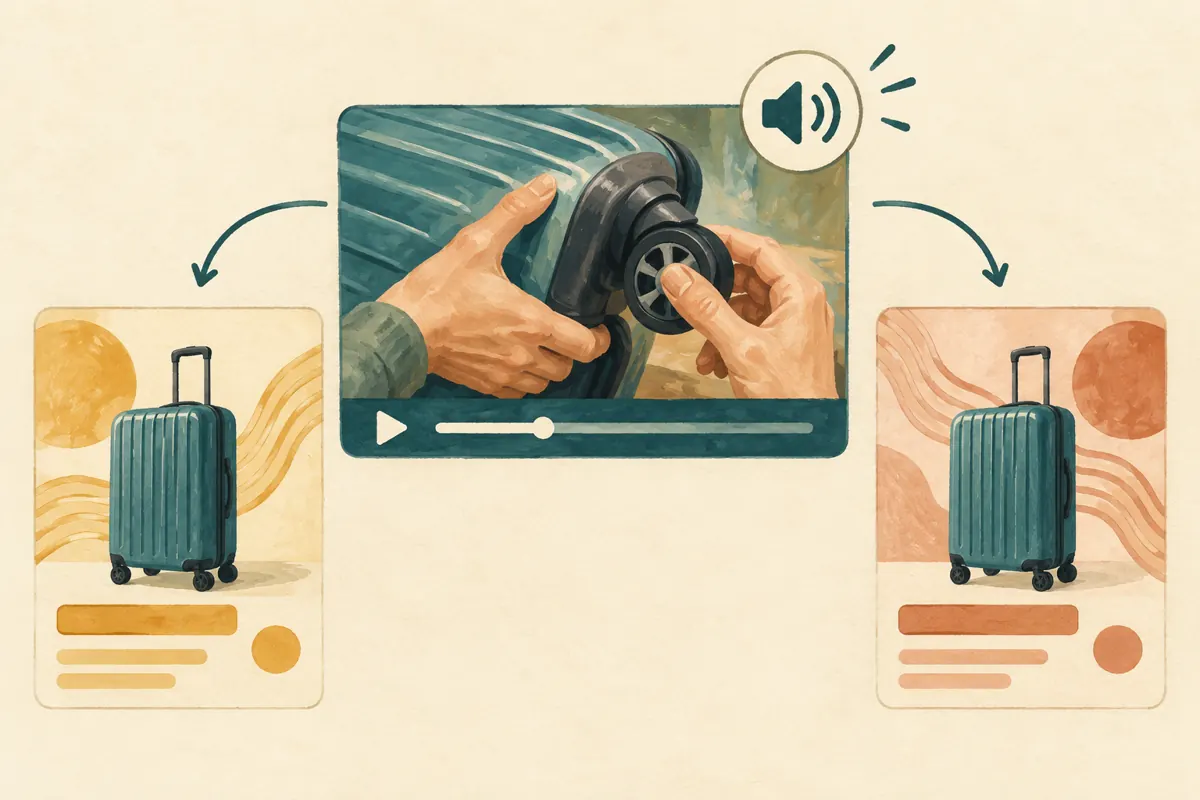
YouTube supports translated video titles and descriptions. These are the words surrounding the video, often called metadata. Adding an English listing does not itself replace Khmer speech, translate text inside the picture, or supply a reviewed English explanation of every repair step. Treat each of those elements as a separate editorial task.
Make the viewing experience clear in the description. In this hypothetical example, an appropriate sentence would be: “Demonstration spoken in Khmer; the close-up shots show which wheel photographs to send.” Only mention English subtitles if they are actually available and checked.
Now watch the demonstration from the intended reader’s perspective. Could someone understand the required photographs from the pictures alone? If a crucial distinction is spoken but invisible, improve that explanation before promoting the English listing. A translated title that attracts someone to an incomprehensible demonstration creates another obstacle between the viewer and a useful enquiry.
3. Build a small fact sheet before writing either version
Collect the facts that both descriptions must preserve: the demonstrated part, what the shop can assess from photographs, when physical inspection is necessary, the actual service location, and the approved contact route. Keep these facts in a compact working document beside the drafts. The person responsible for repairs should verify technical statements.
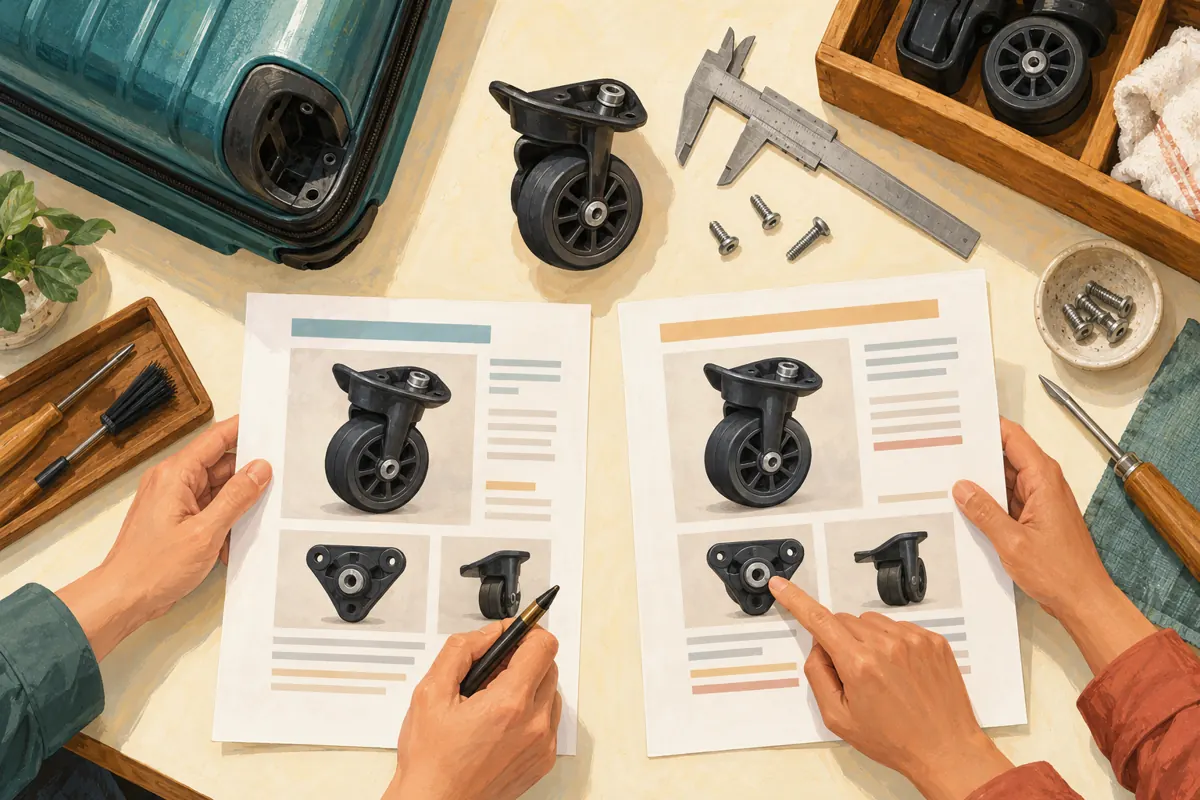
For the hypothetical luggage shop, distinguish the rotating wheel from the complete wheel assembly and the plate that attaches it to the suitcase. A translator may otherwise turn three different components into one general word. Add a reference photograph when the distinction is difficult to explain.
Mark uncertainty explicitly. “Send photographs so we can check possible options” has a different meaning from “Send photographs to book your replacement.” Preserve that difference in both languages. Also check that an inspection request has not become a guaranteed quotation, and that the shop location has not become an unsupported promise of delivery throughout Cambodia.
4. Write a title that names the task and a description that completes it
A hypothetical English title could be “Suitcase Wheel Repair Enquiry: Which Photos to Send.” It identifies the object and the next action without promising a successful repair. Include Phnom Penh only when the location helps explain a real service boundary. Avoid filling the title with unrelated Cambodian place names or repeated repair keywords.
Organize the description around the viewer’s decision. First explain what the demonstration covers. Then identify the photographs needed, state the inspection limitation, and give the shop’s approved contact instructions. Put language information near the beginning when it affects whether the viewer can follow the demonstration.
Read the English draft without looking at the original. It should sound like a shop explaining a practical task, rather than a sentence translated word by word. Then compare it against the fact sheet. Natural phrasing is welcome; a stronger warranty, wider service area, or more certain repair promise is a factual change.
5. Add the translation without relabelling the original speech
Check the video’s original language first. YouTube’s documented route is YouTube Studio, Content, the selected video, Show more, and Language and captions certification. Choose the appropriate language settings and save. A Khmer-spoken demonstration should not be labelled English merely because the shop wants an English-reading audience.
To add translated metadata, YouTube directs creators to Studio’s Subtitles area. Select the video, confirm its language if requested, choose Add language, and select the translation language. Under Title and description, choose Add, enter the reviewed translation, and publish it. This adds a language version to the existing video.
Keep the original wording and the approved translation in the working document. Record which video was edited and who checked the wording. These notes make later corrections easier, especially when one employee handles the channel and another answers repair questions. The shop’s website language configuration does not need to change for this video task.
6. Review meaning with someone who understands the parts
Use two passes. In the first, a language reviewer checks whether the translated text is natural and understandable. In the second, a repair employee checks whether it accurately describes the demonstration. One person may perform both roles if they have the necessary knowledge, but the two questions should remain separate.
Ask the reviewer to explain the English description back in their own words. What should the customer photograph? What will the shop decide afterwards? Is a visit required? This is more revealing than asking whether the translation looks correct. A smooth sentence can still imply that a replacement part is already reserved.
Check small operational details individually: model identifiers, measurements, location spelling, contact names, and any conditions attached to inspection. Machine translation can help produce a draft, but it should not settle uncertain terminology. If nobody can verify a technical phrase, simplify the claim or remove it until the shop can explain it accurately.
7. Test whether a viewer can take the intended next step
After saving, check the published video and inspect the saved language entries in Studio. Do not conclude that a translation was lost solely because your own viewing session shows the original title. Confirm the stored text directly, then ask an English-reading reviewer to examine the translated wording and the viewing experience.
Give that reviewer a specific task: identify which photographs they would send and explain what response they expect from the shop. Do not coach them through the answer. If they expect an immediate repair price, return to the sentence that created that expectation.
Check the contact destination on a phone as well. It should identify the same business and provide a workable way to ask the question. Avoid asking a reviewer to submit unnecessary personal information. The test succeeds when the route and expectations are clear; it does not require a real booking or a public endorsement.
8. Decide what an SMM panel service can establish
The supplied bine.digital catalogue includes “Youtube Views ~ Video/Shorts ~ Max 10M ~ 50k/days ~ Instant ~ 𝐍𝐎 𝗥𝗘𝗙𝗜𝗟𝗟”. Its name identifies a views offering for videos or Shorts. No supporting description was supplied, so its label should not be treated as verified evidence of delivery speed, viewer location, genuine interest, or a particular promotional method.
A views offering does not perform the translation review described here. Purchased engagement is not evidence that people understood the English listing, that Cambodian customers watched, that advertising was delivered, or that sales resulted. A larger public count cannot answer whether viewers know which photographs to send.
YouTube prohibits artificially increasing engagement metrics and warns that a hired promoter’s actions can affect the channel. Do not order artificial engagement to test this translation. If a proposed service’s method is unclear, stop and request a substantive explanation. For this workflow, language review, clearer filming, and responding to genuine enquiries provide more relevant work than buying a count.
9. Judge the revision through actual enquiry quality
Define a useful enquiry before reviewing results. For the hypothetical shop, it would identify a suitcase problem and include photographs that let staff decide whether further inspection is needed. It would not require the customer to know a technical part name. Clear communication should make the task easier for a non-specialist.
Keep brief, anonymous notes about recurring misunderstandings. Perhaps customers send only the suitcase front, omit the mounting area, or assume the shop stocks every brand. Each pattern points to a concrete editorial change. Record the question category rather than copying private conversations into a promotion report.
When customers voluntarily explain how they found the demonstration, preserve that context without turning it into stronger attribution. An enquiry after a translation change does not prove the change caused it. Review the listing alongside staff observations and the actual messages. A quieter period may simply provide too little evidence for a conclusion.
10. Avoid translation drift when the offer changes
Treat the language versions as a connected set whenever a business fact changes. If the shop stops assessing a particular wheel type, review the original description, the translated description, and the demonstration’s own claims. Updating one description cannot repair a conflicting promise spoken in the video.
Common mistakes include translating an old draft, expanding “assessment” into “repair”, adding location keywords that imply unavailable service coverage, and describing subtitles that were never checked. Another is changing the title, thumbnail, offer, and contact route together, then attributing every later difference to translation.
Assign one person to maintain the fact sheet and note the reason for each meaningful revision. Before the next round of promotion, have the employee answering enquiries check the current wording. That final review connects the public explanation with what the shop can actually do when someone arrives with a damaged suitcase.

Frequently asked questions
Should the shop replace its Khmer title with an English title?
It does not need to do that merely to offer an English listing. Use the translated title and description fields for the additional language. Keep the original version accurate for its audience, and review both versions whenever service facts change.
Is an English description enough if the video is spoken in Khmer?
It depends on the task. A simple photographic enquiry guide may be understandable through close-ups and a clear description. A detailed spoken explanation may need reviewed subtitles or another accessible explanation. Ask an English-reading reviewer to demonstrate understanding before deciding the video is ready.
Will translated titles guarantee more Cambodian customers?
No. A translation can make a listing understandable to another reading audience, but it does not establish location, buying intent, or demand. Evaluate whether actual enquiries contain the information staff need. Do not treat language choice or a public view count as proof of Cambodian customer acquisition.
What if staff disagree about the English name of a wheel component?
Use the part photograph and describe its function in plain language. Ask the repair employee to confirm that the wording identifies the correct component. Avoid publishing a confident technical label while the team is uncertain, especially if it could imply compatibility with other suitcases.
Can the shop compare purchased views before and after translation?
That comparison cannot establish comprehension or sales impact. Purchased engagement introduces activity unrelated to the editorial question, and artificial engagement conflicts with YouTube’s policy. Use direct comprehension checks and genuine enquiry observations to decide what to improve.
Explore the current service catalogue, create an account, or ask a specific question through support tickets.
- YouTube Help: Translate your own video titles and descriptions
- YouTube Help: Change the language of your uploaded video
- YouTube Help: Fake engagement policy
Prepared with AI assistance. Illustrations explain the workflow and do not represent customer results.