20/10/2026 12:44
Where Did the Care Guide Travel? Telegram Forward Reviews for Cambodian Mat Shops

A useful mat-care guide can circulate beyond the shop that posted it. Someone shares it with a household, a retailer passes it along, or a public channel includes it among home-care tips. For a Cambodian woven-mat business, the practical question is what to learn from that circulation before spending more on promotion. A rising view counter cannot answer everything. This workflow follows one care post from preparation through a public-forward review, then turns the findings into a better customer resource. It also explains where SMM panel records belong, without treating purchased activity as proof of local interest or sales.
1. Choose a question that sharing could help answer
Start with a narrow editorial question: does this guide reach places where people discuss storing woven mats? That gives the review a useful purpose. Looking only for a larger counter encourages vague conclusions, while looking for relevant context can reveal missing information. A shop might discover that readers need a clearer distinction between the mat's flat dimensions and its size when rolled.
Consider a hypothetical shop in Kampong Cham preparing a storage guide for one specific reed-mat model. Its owner wants customers to recognise the material, understand the supplier-approved care instructions, and know what to send when asking about storage space. The review should therefore look for relevant sharing contexts and concrete questions. It should not begin with a target number of forwards or an assumption that every person seeing the guide is shopping.
2. Make the guide understandable away from your channel
Prepare the post as a self-contained resource. Identify the pictured material and model, explain the task being demonstrated, and state any important limits. Care advice should come from information verified for that product; do not turn one supplier's instructions into a rule for every woven mat. Use photographs that show the relevant surface, edge or storage position clearly.
For a Khmer-speaking audience, write the customer-facing guide in natural Khmer and check it with someone who understands the product. This does not require changing the website's language. Include a simple next step, such as asking readers to send the model and available shelf dimensions to the shop's established contact. Avoid references such as 'the offer above' or 'yesterday's size': a recipient encountering the post elsewhere may never see those surrounding messages.
Before sharing, have a colleague read the guide by itself. Ask them to identify which mat it covers and what information they would need before contacting the shop.
3. Understand the evidence Telegram actually provides
Telegram's Channels FAQ explains that a post's view total includes views of forwarded copies. The total is approximate, and repeat viewing can be counted again after Telegram forgets an earlier view. Treat that counter as a circulation indicator, not a count of unique prospective customers. Source: https://telegram.org/faq_channels#q-what-does-the-eye-icon-mean
Telegram also documents individual post statistics that include public channels to which a post was forwarded. This can provide context about visible redistribution, but it is not a complete map of private sharing or a customer identity report. Source: https://telegram.org/blog/pinned-messages-locations-playlists#channel-post-stats
Check which statistics your authorised administrator account can actually access. Telegram's technical documentation says detailed channel statistics depend on a server-configured eligibility threshold. Avoid building the workflow around a promised subscriber number. If statistics are unavailable, continue with the original post, visible evidence and voluntarily reported customer sources. Mark the missing information as unavailable. Source: https://core.telegram.org/api/stats
4. Create a small review record before promotion
Keep one record for the guide, including its original link, publication time, product reference and current wording. Add the question the review should answer and the person responsible for checking it. Record material changes, such as replacing an ambiguous photograph or correcting a storage instruction, so later observations refer to the right version.
Choose review times your team can maintain. For example, a hypothetical shop could inspect the post the next working day and again the following week. These are organisational choices, not recommended performance benchmarks. Record the observation time in Cambodia time and compare posts at similar ages where possible.
Also note distribution you already know about: a placement agreed with another business, an existing customer newsletter, or a service request. Otherwise, the team may later describe deliberately arranged exposure as spontaneous discovery. A short factual note is enough; this record should support decisions rather than become an administrative project.
5. Read the public context before judging the forward
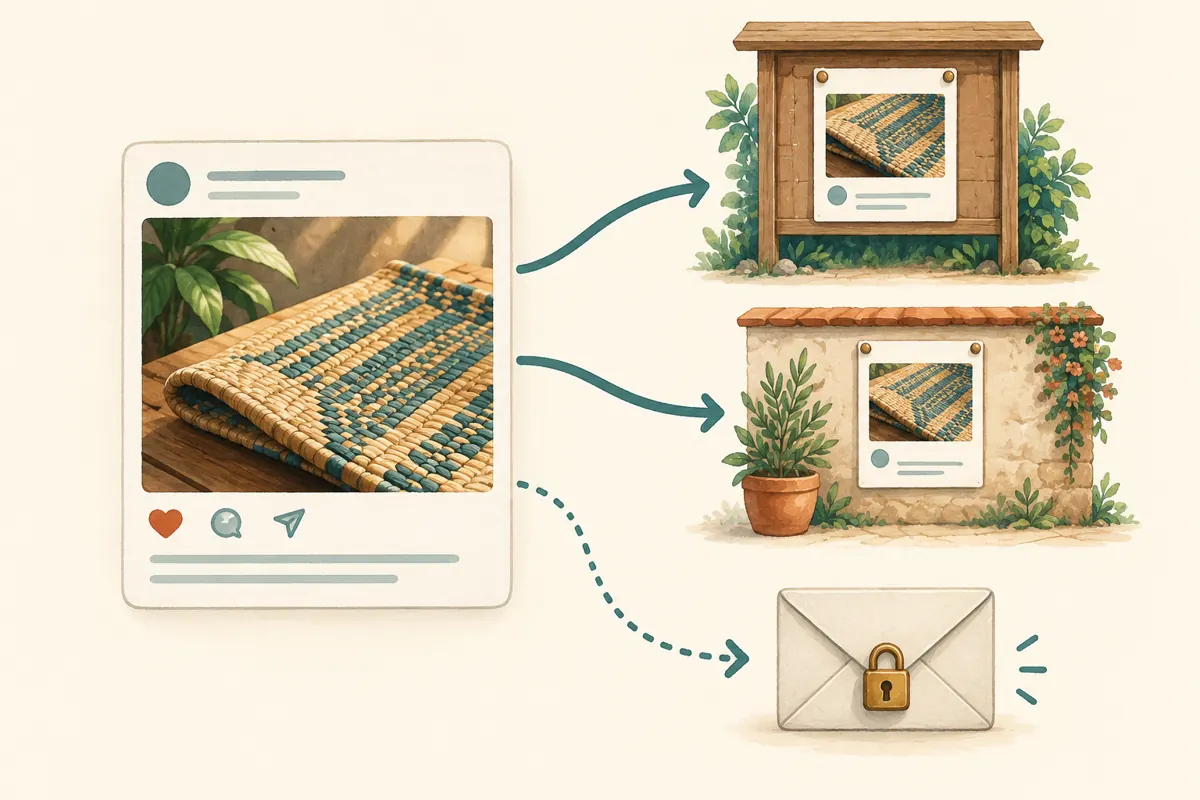
Where the app exposes post statistics, open the relevant post's statistics and inspect any available public-forward entries. Interface labels and placement may vary, so work from the options actually shown. Follow the visible public reference and check whether the surrounding material helps explain why the guide was shared.
Record the public post reference, observation date, topic of the destination and any added wording that changes the meaning. Separate observation from interpretation. 'The guide appears beside household storage advice' is an observation. 'These readers will buy our mats' is an unsupported prediction. A channel name containing a Cambodian place does not establish where its readers live.
Do not collect subscriber identities or approach people merely because the post appeared in a channel. Telegram explicitly warns against sending unsolicited channel links or messages to strangers. A public forward is useful context, not permission to contact an audience. Source: https://telegram.org/faq_channels#q-how-do-i-add-people-to-my-channel
6. Connect enquiries to the guide without forcing attribution
When someone contacts the shop, answer their practical question first. If knowing the source would help, ask an optional, simple question: did they find the guide in the shop's channel, through a forwarded message, or somewhere else? Allow 'not sure'. A buyer should not need to reconstruct their browsing history before receiving a useful answer.
Keep the customer's stated source separate from the staff member's assumption. A customer saying that a relative forwarded the guide supports a private-sharing explanation for that enquiry. It does not reveal the whole sharing chain. Someone asking about the same mat shortly after publication may have seen it in the shop window instead.
Classify the substance of enquiries too. A care clarification, a request for rolled dimensions and a confirmed purchase represent different outcomes. This distinction helps the business see whether the resource is useful, whether the product presentation needs work, and whether an actual transaction occurred.
7. Keep SMM service activity out of organic-sharing conclusions
The supplied bine.digital catalogue includes the exact service name 'Telegram - Views ~ INDIA ~ BOT ~ 1 POST'. Its title labels it as a bot-view offering for one post with an India designation; the supplied description is empty. That information does not establish Cambodian reach, genuine interest, forwarding behaviour or suitability for this shop's objective. The title is a catalogue label, not independent verification of delivery characteristics.
For a review intended to learn how a care guide circulates naturally among relevant readers, introducing purchased views would complicate interpretation. The sensible decision is to avoid using that activity as a research shortcut. If a service order already overlaps the review, record its target and timing separately and describe the resulting view history as affected by additional activity.
Do not subtract a claimed delivery quantity from Telegram's counter and call the remainder unique organic viewers. The measures do not establish that calculation. Purchased engagement is not evidence of sales, ad delivery, Cambodian users or customer approval. A panel's order status answers a different question from whether the guide helped a buyer.

8. Turn observations into one specific content improvement
Use a simple decision process. If relevant sharing is visible but enquiries repeatedly misunderstand the same instruction, clarify the guide. If enquiries are useful but their source is uncertain, keep answering them and leave attribution unresolved. If neither relevant sharing nor enquiries are visible, review the guide's usefulness and distribution context before assuming the answer is more paid activity.
In a hypothetical example, the Kampong Cham shop finds its guide in a public home-organisation channel. Separately, a reader asks whether a rolled mat will fit inside a cabinet. The shop cannot claim the forward caused that enquiry without more evidence. It can still improve the resource by photographing the rolled diameter and explaining how to measure the available space.
Change one meaningful element for the next guide, such as the opening question or measurement photograph. Keeping the rest reasonably consistent makes the editorial lesson easier to interpret, although this remains a practical review rather than a controlled experiment.
9. Avoid the mistakes that make sharing reports misleading
A frequent mistake is adding the original post's views to figures seen elsewhere and presenting the sum as a unique audience. Another is describing every visible forward as an endorsement. A destination might share a post to question it, compare products or discuss a problem. Read the context before assigning a positive meaning.
Do not infer that an empty public-forward list means nobody shared the guide. Equally, do not invent invisible sharing to explain weak results. Use precise language: no relevant public forward was observed during this review. That statement preserves what the team knows without claiming a complete picture.
Avoid changing several things while judging one post: the product, image, wording, distribution and contact route. When necessary changes overlap, document them and reduce the confidence of your conclusion. Also resist asking staff to manufacture a trail of forwards. That would measure the team's distribution activity, not independent reader interest.
10. Finish with a decision the shop can act on
Close the review with three short statements: what was observed, what remains unknown, and what will change. A hypothetical conclusion could say that a storage-themed public channel shared the guide, the available evidence does not connect that forward to purchases, and the shop will add a rolled-size photograph. This is useful even when the figures are modest.
Assign the change to a named staff role and choose when to review the revised resource. Keep the care guide available for customer service if it answers a recurring question, even if it does not produce obvious sales. Its value may be helping someone choose correctly or understand an item they already own.
Before committing another promotion budget, ask whether the proposed spend addresses the observed problem. Unclear instructions need clearer content; unanswered enquiries need staff attention. A service that changes a visible count cannot resolve either issue by itself.

Frequently asked questions
Can a small channel use this workflow without detailed statistics?
Yes. Keep a record of the guide, review incoming questions and note any public sharing you can directly verify. Ask customers about their source only when useful and optional. You can improve confusing instructions without detailed analytics. Leave unavailable fields blank rather than buying activity to pursue an assumed eligibility threshold.
Does a forward from a Cambodian channel prove local buying interest?
No. It shows the post appeared in that public context. The channel's name, language or topic does not verify every reader's location or intention. A relevant product enquiry provides different evidence, and a completed purchase requires its own transaction record. Keep those observations separate.
Should we ask another shop to share the guide?
A relevant business relationship can support agreed sharing when the resource is useful to both audiences. Confirm the context and any commercial arrangement, then record the placement as planned distribution. Do not present an arranged forward as an unsolicited recommendation or ask the other shop to imply experience it does not have.
What if a public forward adds incorrect care advice?
First confirm the correct instructions for the specific product. Publish a clear clarification through your own customer-facing channels and, where an appropriate contact route exists, request a correction from the destination's administrator. Keep the request factual. Do not assume that changing your original post resolves every separately written claim.
When should the shop stop reviewing a post?
Stop when the planned review window ends and you have a decision, or when further checking is unlikely to change that decision. Reopen the review if a substantive new question or misleading public context appears. Routine monitoring should not take more staff time than improving the guide and helping customers.
Explore the current service catalogue, create an account, or ask a specific question through support tickets.
- Telegram Channels FAQ: What does the eye icon mean?
- Telegram: Channel Post Stats
- Telegram technical documentation: Channel statistics
- Telegram Channels FAQ: How do I add people to my channel?
Prepared with AI assistance. Illustrations explain the workflow and do not represent customer results.